 Login / Register
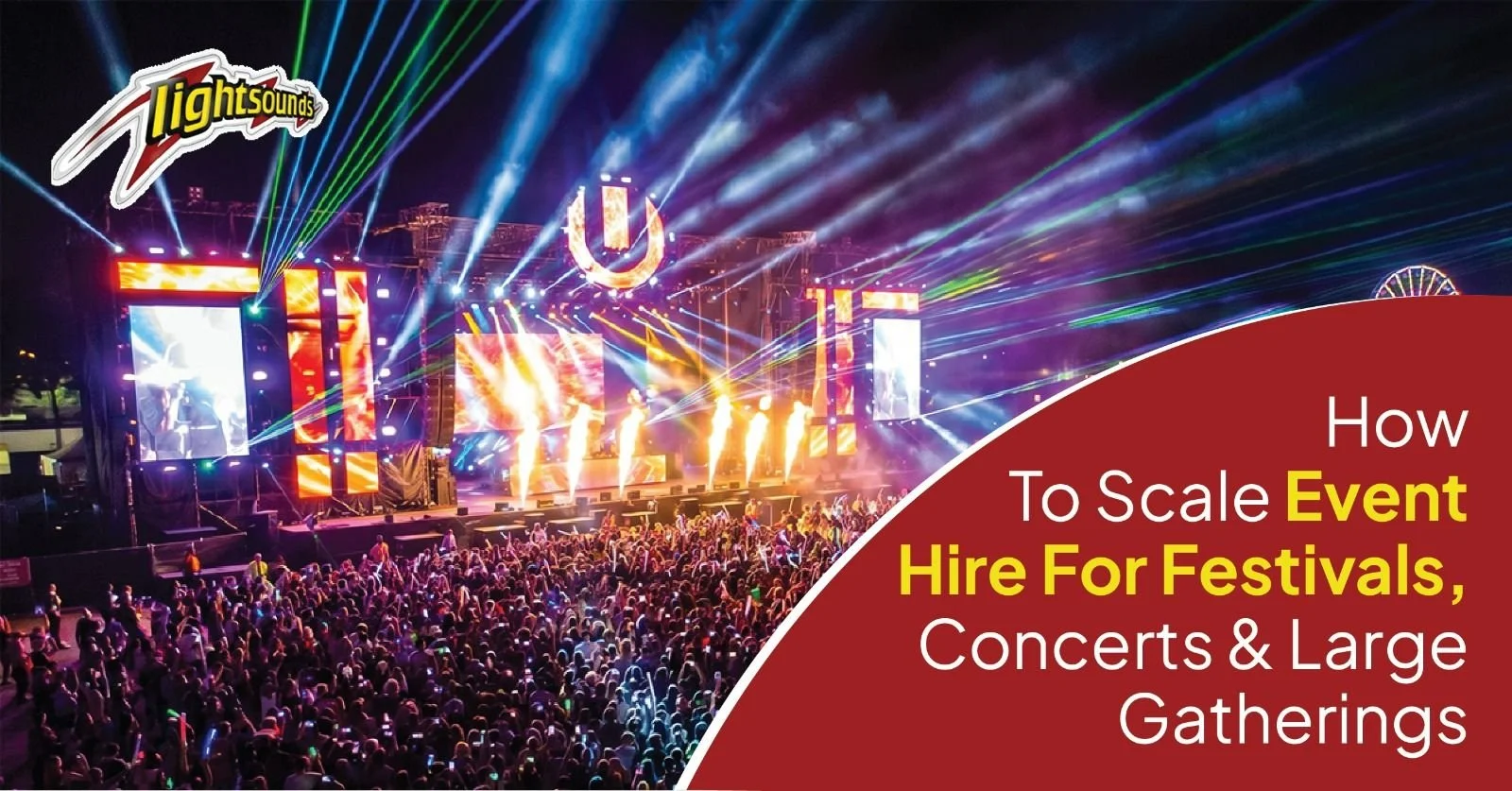
Moving from a small event to a festival, concert or large gathering changes almost every part of the production setup. More guests mean larger audience areas, greater sound coverage, more complex lighting, additional power requirements and more detailed logistics.
The solution is not simply to hire more equipment. Large events need equipment that works together as a complete system.
When planning event hire for festivals, concerts and large gatherings, organisers need to consider the venue, audience size, stage design, audio coverage, lighting requirements, power, access and technical support from the beginning.
What Changes When an Event Gets Bigger?
A small private event can often operate with a compact PA system, a few lighting fixtures and straightforward equipment setup.
A large event may require:
- Multiple speaker positions
- Line array or larger PA systems
- Subwoofers
- Stage monitoring
- Digital mixing systems
- Wireless microphones
- Stage and performance lighting
- Moving lights and effects
- Lighting control systems
- Trussing and staging
- Power distribution
- Additional cabling and signal management
- Technical crew and event operators
The larger the event becomes, the more important it is to design the equipment setup around the whole site rather than treating every item individually.
How Do You Plan Equipment for a Large Event?
Start by dividing the event into functional areas.
For example:
Main Stage
The main stage may require:
- Main PA system
- Subwoofers
- Stage monitors
- Wireless microphones
- Digital mixing console
- Stage lighting
- Moving lights
- Lighting control
Audience Area
The audience area needs appropriate sound coverage and, depending on the event, lighting for safe movement and wayfinding.
Large sites may require additional speaker positions or delay systems to provide more consistent audio coverage.
Secondary Areas
Festivals and large gatherings may also include:
- Secondary stages
- Food and beverage areas
- VIP spaces
- Entry points
- Merchandise areas
- Sponsor displays
- Outdoor activity zones
Each area may have different audio and lighting requirements.
How Does Audio Scaling Work for Festivals and Concerts?
One of the biggest mistakes when scaling an event is assuming that adding more speakers automatically solves the problem.
Large venues require a planned approach to sound coverage.
Depending on the event, a professional audio system may include:
- Line array speakers
- Subwoofers
- Front-fill speakers
- Delay or distributed speaker systems
- Stage monitors
- Digital mixing consoles
- Wireless microphone systems
The appropriate configuration depends on the audience size, venue dimensions, stage position, acoustic environment and required coverage.
For a large outdoor event, sound also needs to be managed with consideration for the surrounding environment and any applicable venue or local requirements.
How Should Lighting Scale for a Large Event?
Lighting requirements also change significantly as an event grows.
A small function may only require uplights and a few LED fixtures. A concert or festival may require a complete stage lighting system.
Large-event lighting can include:
- Stage wash lights
- Moving lights
- Beam fixtures
- LED fixtures
- Follow spots
- Audience lighting
- Architectural lighting
- Effects lighting
- Lighting control systems
Lighting should be designed around the stage, performers, audience and event schedule.
For example, a concert may require dynamic lighting during performances, while a corporate event may prioritise clear presenter visibility and controlled stage lighting.
Why Is Power Planning Important for Large Events?
Large audio and lighting systems can require significantly more power than a small event setup.
Before equipment is finalised, consider:
- Available venue power
- Equipment power requirements
- Distribution points
- Cable runs
- Generator requirements where applicable
- Backup arrangements
- Equipment location
- Safe cable management
Power planning should be completed as part of the overall technical design rather than treated as a last-minute requirement.
For complex productions, electrical and power requirements should be assessed by appropriately qualified professionals and in accordance with venue and applicable regulatory requirements.
How Does Venue Layout Affect Event Hire?
The venue layout can influence almost every equipment decision.
Before confirming your hire requirements, map out:
- Stage position
- Audience capacity and layout
- Speaker locations
- Lighting positions
- Dance floors
- Entry and exit points
- Back-of-house areas
- Equipment loading areas
- Power locations
- VIP and hospitality areas
This site plan can help identify potential equipment, cable and access issues before the event.
For outdoor festivals, also consider ground conditions, weather exposure, distance between the stage and audience, vehicle access and equipment protection.
How Can Modular Equipment Make Large Events Easier?
Modular equipment can make it easier to adapt a production to different event sizes.
Instead of creating a completely different system for every event, compatible equipment can be combined according to the requirements.
For example:
Small event:
Compact PA + wireless microphone + basic LED lighting
Medium event:
Larger PA + subwoofer + DJ equipment + stage lighting
Large event:
Professional PA + multiple speaker positions + subwoofers + stage lighting + moving lights + technical control
This approach can make equipment planning more flexible while helping organisers avoid hiring equipment that is not required.
What Role Does Technical Support Play in Large Events?
As the complexity of an event increases, technical operation becomes more important.
A large production may involve multiple audio sources, lighting fixtures, control systems and equipment locations.
Technical support may be required for:
- Equipment installation
- Audio setup
- Lighting programming
- System testing
- On-site operation
- Troubleshooting
- Pack-down
For a simple event, equipment-only hire may be sufficient. More complex festivals, concerts and large gatherings may benefit from professional installation and technical operation.
How Can You Manage Event Hire Costs as Your Event Grows?
Scaling an event does not mean hiring the maximum amount of equipment available.
Start with the essential requirements:
1. Define the audience area
Determine where guests will be located and how large the coverage area is.
2. Prioritise essential audio
Make sure speeches, performances and music can be heard clearly before adding additional effects.
3. Prioritise essential lighting
Stage and presenter visibility should come before decorative effects.
4. Add equipment according to the event format
A concert, festival, corporate event and wedding may all require different equipment even if the audience size is similar.
5. Confirm logistics early
Delivery, access, installation and pack-down requirements can all affect the overall cost and schedule.
A properly planned system can help avoid both under-hiring and paying for equipment that does not add value to the event.
What Should You Check Before Hiring Equipment for a Festival or Concert?
Before confirming a large-event hire setup, create a technical checklist covering:
- Event date and duration
- Venue location
- Audience capacity
- Site layout
- Stage dimensions
- Audio coverage requirements
- Lighting requirements
- Power availability
- Equipment access
- Delivery schedule
- Installation requirements
- Technical operation
- Weather considerations
- Pack-down and collection
- Venue restrictions and approvals
For large events, these details should be confirmed well before the event date so equipment and technical resources can be scheduled appropriately.
How Can You Make a Large Event More Efficient?
Good event production is not only about equipment. It is also about coordination.
A clear production plan should identify:
- Which equipment is required
- Where each item will be positioned
- Who is responsible for installation
- When equipment needs to arrive
- When testing will take place
- Who will operate the systems
- How pack-down will be managed
Creating this plan early can reduce last-minute changes and help different teams work together more effectively.
Why Choose Lightsounds for Large Event Hire?
Lightsounds provides audio, lighting, DJ and event equipment hire for a range of events across Australia.
Depending on the event requirements, equipment can be selected for different production scales, from smaller private functions through to larger corporate events, festivals, concerts and other productions.
Lightsounds can also support event requirements involving delivery, installation and technical operation, depending on the equipment and service required.
For a large event, discussing the venue, audience, stage design and production requirements in advance can help identify a more suitable combination of audio, lighting and event equipment.
Frequently Asked Questions
What equipment do I need for a large festival?
- A large festival may require a professional PA system, subwoofers, stage monitors, microphones, stage lighting, moving lights, control systems, power distribution and technical support. The exact setup depends on the venue, audience size and event format.
When should I book event equipment for a large event?
- Large events should be planned well in advance because equipment availability, delivery, installation and technical resources all need to be coordinated. The required lead time depends on the size and complexity of the production.
Do large outdoor events need line array speakers?
- Not necessarily. Line arrays can be suitable for certain large-scale events, but the appropriate audio system depends on audience size, venue dimensions, required coverage, stage design and acoustic conditions.
How much lighting is needed for a concert?
- There is no fixed number of lighting fixtures for every concert. The requirement depends on stage size, performers, production design, audience area and the desired visual effects.
Do large events require professional technical support?
- Not every event does, but larger and more complex productions can benefit significantly from professional installation, system testing and technical operation.
How do I reduce the cost of large-event equipment hire?
- Start by identifying the actual requirements of the venue and event. Avoid hiring equipment that does not contribute to sound coverage, lighting, safety or the overall production. Confirm delivery, installation and technical requirements early to reduce unexpected costs.
Scale Your Event with the Right Equipment
Large events require more than simply adding equipment to a small-event setup. Audio coverage, lighting, staging, power, venue layout and technical operation all need to work together.
The best approach is to start with the event requirements, design the technical setup around the venue and audience, and then select equipment that provides the required coverage and functionality.
Whether you are planning a festival, concert, corporate function or large gathering, Lightsounds’ event equipment hire can help you explore audio, lighting and DJ equipment suitable for your production requirements.


